Isaac* arrived at Active Neuro Kingswood Nottingham at a very complex and uncertain point in his recovery. While on holiday abroad, Isaac developed a sudden severe headache and was admitted to hospital, where he was diagnosed with a subarachnoid haemorrhage. His condition deteriorated due to obstructive hydrocephalus, and he required a prolonged period of critical care.
Following a period of medical stabilisation, Isaac was transferred back to the UK and underwent a detailed assessment of his level of consciousness. As his responsiveness began to improve, further discussions were held with the neurosurgical team regarding the management of his hydrocephalus. Isaac also lives with pre-existing severe osteoarthritis affecting his right hip and knee, as well as a history of surgery to his left knee, which adds further complexity to his physical rehabilitation. Before his illness, Isaac lived independently and managed all aspects of daily life without support. He lived alone, was fully self-caring and was an active and well-known member of several national interest and activity clubs.
Isaac arrived at Active Neuro Kingswood Nottingham in May 2025, and at this point he required a full hoist for all transfers and mobility. He was unable to sit independently, stand, undertake personal care or eat a meal without assistance. He was disoriented to his surroundings, his condition and his personal circumstances, and experienced significant confusion. Isaac had also developed severe muscle wasting because of his prolonged critical illness.
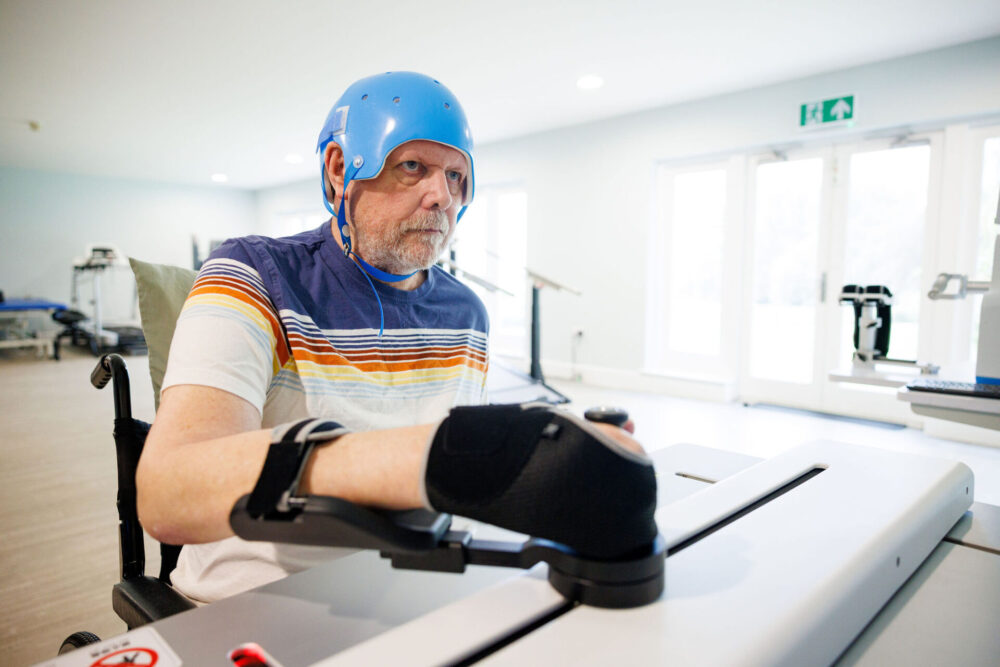
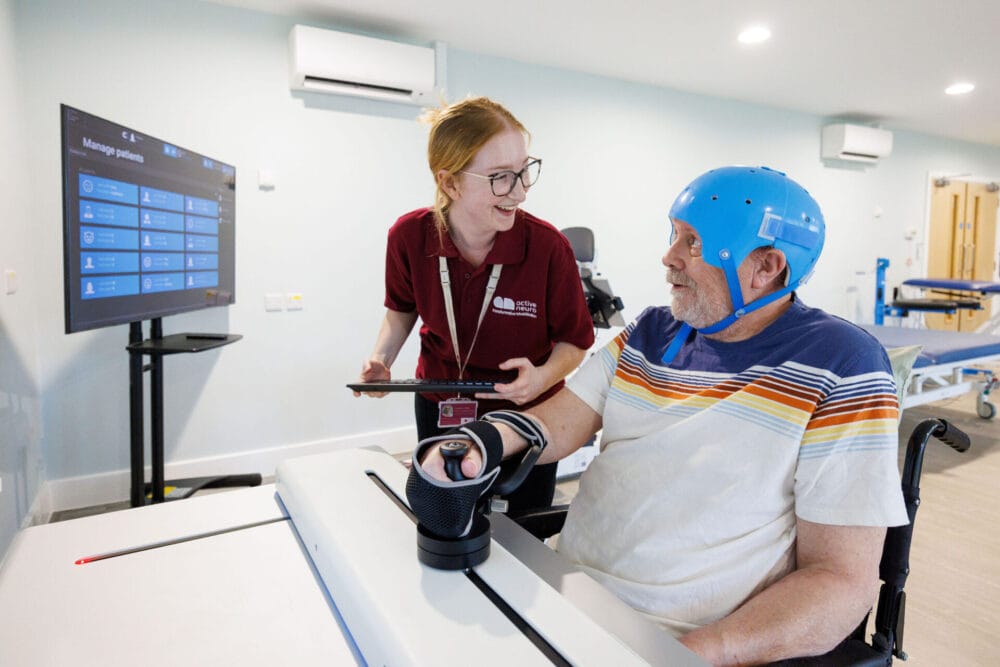
Isaac receives a comprehensive programme of specialist rehabilitation, including Physiotherapy, Occupational Therapy, Speech and Language Therapy, Psychology, Music Therapy, Dietetic and nutritional support. He also engages in activities coordination and is an active and valued member of the hospital community. He works particularly hard within physiotherapy sessions and enjoys the social interaction that therapy brings. Isaac has also embraced the use of assistive technology games introduced during his admission through the ArmMotus™ M2 Gen. This has helped motivate and challenge him throughout his recovery.
His active range of motion increased from 132 cm2 to 1,872 cm2, while his passive range of motion improved from 1,200 cm2 to 1,872 cm2, highlighting the significant gains he has made through ongoing therapy and rehabilitation. This level of improvement and range of motion would assist Isaac in his ability to carry out his own personal care.
Isaac takes part in Breakfast Club, dog therapy sessions and a range of social events on the unit, making an active and enthusiastic contribution. He completes around ten hours of physiotherapy each week and enjoys being involved in interactive and competitive tasks. Since beginning specialist rehabilitation, Isaac has made steady and meaningful progress. He is now able to stand with assistance and walk short distances with the support of therapists. He can independently complete personal care whilst sitting and is able to prepare breakfast with supervision. He takes part in drawing and music activities during therapy sessions and is able to play instruments.
He has developed a much better understanding of his condition and his current limitations, and has made significant improvements in his cognitive skills, enabling him to take responsibility for parts of his daily routine that were previously not possible. He is also able to move around the building independently using a self-propelling wheelchair, giving him greater autonomy and control over his day. Isaac is fully involved in his rehabilitation planning, with regular discussions to ensure his goals remain central to his care. He is encouraged to make decisions about his therapy and daily routine, with support when needed to help him understand options and likely outcomes.
Some of the most meaningful milestones for Isaac have included being able to get into a car to attend an appointment at a local hospital and walking the full length of the therapy gym with support. His goal is to return home and live as normal a life as possible, with the opportunity to visit friends and take part in social activities. He would like to regain the ability to walk independently and to return to riding his bike. His rehabilitation programme continues to focus on both the physical and cognitive skills required for independent living, shaped around his personal goals and future aspirations.
*Name changed for privacy